
The short version
- A wand cleans a narrow strip, and the force changes every time the distance or angle does. That's where lines come from.
- A surface cleaner spins its nozzles at a fixed height under a housing, for an even pattern with little overspray.
- Pros use both: the surface cleaner for the open concrete, the wand for edges, steps and the final rinse.
How a wand cleans
A pressure washer wand ends in a nozzle tip that shapes the water into a fan. Tips are rated in degrees: the lower the number, the narrower and more concentrated the stream (Consumer Reports). The fan is strongest in a narrow line and gets gentler with every inch of distance.
That's fine for small areas. Across a whole driveway, though, the person holding the wand is making thousands of small changes: closer here, farther there, a slight tilt at the end of each sweep. Each pass cleans a little differently, and the edges of passes show up as lines once the concrete dries. The Brick Industry Association's guidance on walls explains why: good results depend on keeping a consistent pressure, flow, distance and angle, with uniform strokes, and that takes skill (BIA).
How a surface cleaner cleans
A rotary surface cleaner is a round housing with a spinning spray bar inside. Typically, the spray from the angled nozzles is what turns the bar, sweeping the nozzles in a circle just above the concrete. Mi-T-M, a pressure washer maker, says its surface cleaners clean large, flat surfaces faster and easier than a standard nozzle, and that the brush around the edge eliminates overspray and maintains the distance between the nozzles and the surface, which ensures a balanced and even cleaning pattern (Mi-T-M).
Two things still matter with a surface cleaner: the pace, and the match to the machine. PowerWash.com notes that walking too fast causes swirl stripes, and that the right surface cleaner size depends on the machine's GPM and horsepower (PowerWash.com). More flow also helps cover large areas faster; Popular Mechanics recommends investing in higher GPM for regular concrete cleaning (Popular Mechanics).
| Wand alone | Surface cleaner | |
|---|---|---|
| Distance to concrete | Changes with the operator's hand | Fixed by the housing |
| Pattern | Narrow strips; edges can show as lines | Overlapping circular sweeps; even when paced right |
| Overspray | In our experience, water and grime often spray onto nearby walls, cars and beds | Contained by the brush skirt |
| Best for | Edges, steps, corners, curbs, rinsing | Open driveways, sidewalks, patios |
Why the wand still matters
A round cleaner can't reach into an inside corner, up a step face or along a curb edge. So the wand finishes the details and does the final rinse that pushes the loosened grime off the concrete. PWNA's flatwork training covers equipment settings and cleaning patterns together (PWNA), because a good flatwork job uses the right tool for each part of the slab.
What it looks like on a real job
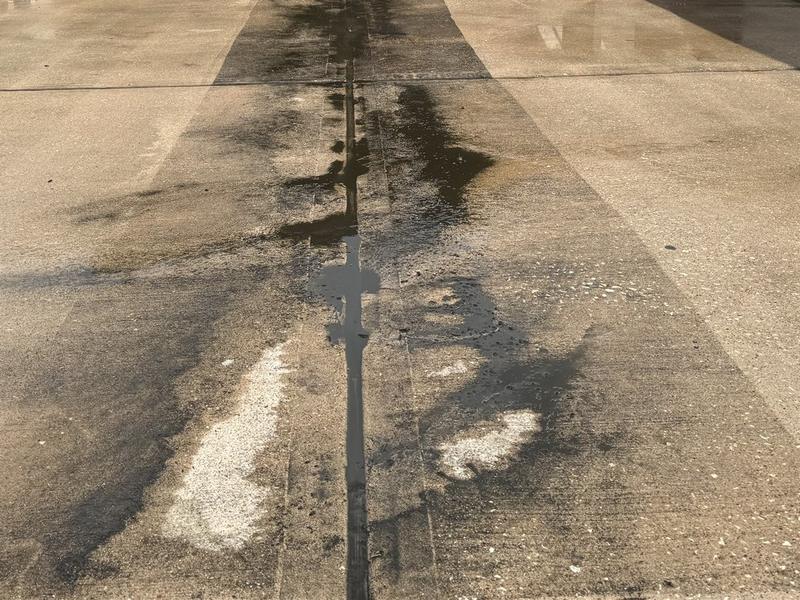

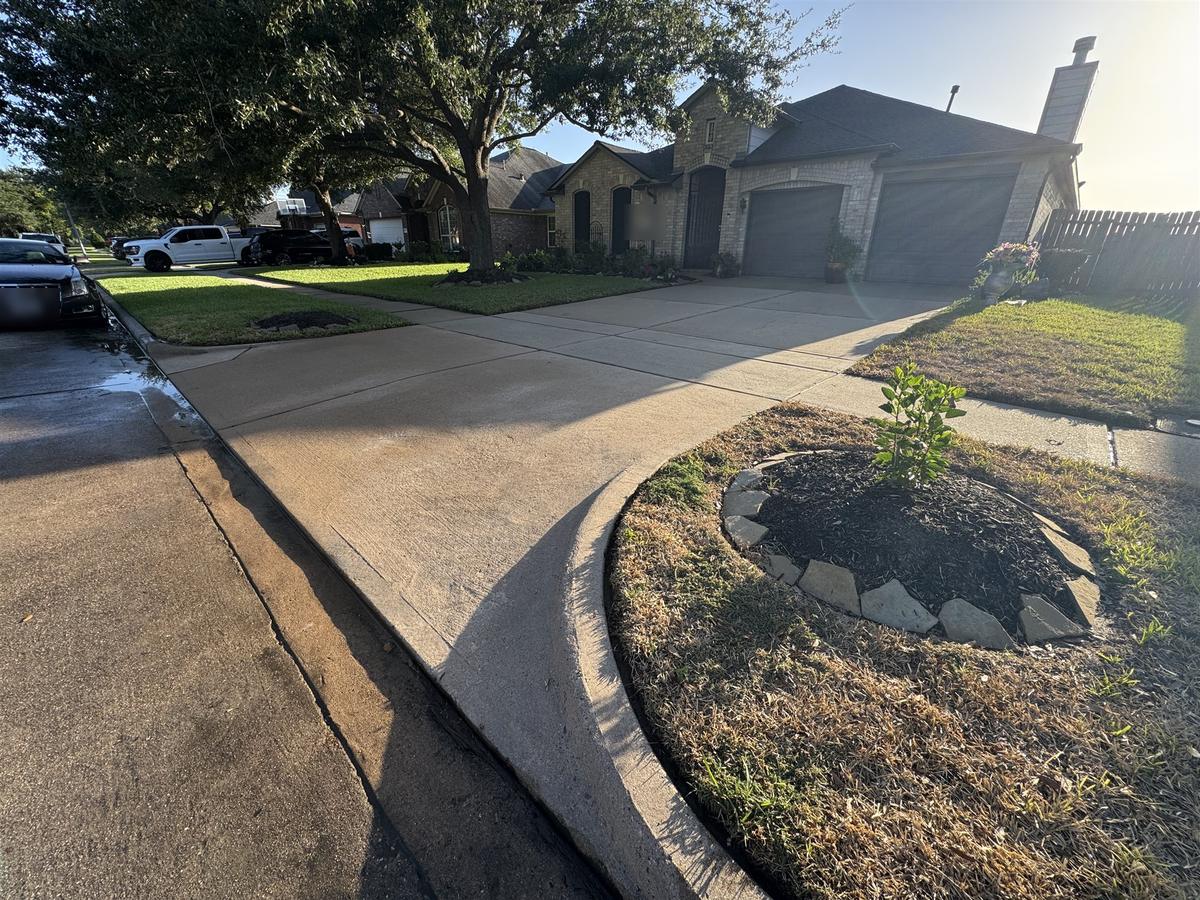
How ACE does flatwork
ACE cleans driveways and sidewalks with a 20-inch surface cleaner on a 3,000 PSI, 5.5 GPM pressure washer, then details the edges and rinses with the wand. We generally apply any cleaning solution after the surface-cleaner pass (a post-treatment) rather than before it.
On concrete, ACE's wand work uses a turbo (rotary) nozzle instead of a plain fan tip. Nozzle maker AR North America explains that a turbo nozzle turns a zero-degree jet into a rotating, cone-shaped spray, combining the intensity of a zero-degree jet with the coverage of a fan spray, and it cautions that turbo nozzles can damage soft surfaces such as wood and paint (AR North America). In our experience, that moving stream helps avoid the straight lines a fan tip can leave, though pace and overlap still matter.
Quick answers
Why does a pressure washer wand leave lines on concrete?
A wand cleans a narrow strip, and its force changes whenever the distance or angle changes. Across a whole driveway those small changes add up, and the edges of passes show as lines once the concrete dries.
What does a surface cleaner do differently?
A rotary surface cleaner spins its nozzles at a fixed height under a round housing. Pressure washer maker Mi-T-M says the brush skirt eliminates overspray and maintains the distance to the surface, for a balanced and even cleaning pattern.
Can a surface cleaner leave stripes too?
Yes, if it's moved too fast or doesn't match the machine. Walking slowly in overlapping lanes and using a cleaner sized for the machine's flow avoids most swirl marks.
Do pros still use a wand on driveways?
Yes. A round surface cleaner can't reach corners, step faces or curb edges, so the wand handles the details and the final rinse.
What equipment does ACE use on driveways?
A 20-inch surface cleaner on a 3,000 PSI, 5.5 GPM pressure washer, with a turbo (rotary) nozzle for wand work on concrete. We generally apply any cleaning solution after the surface-cleaner pass rather than before it.
Sources
- Pressure Washer FAQ: PSI vs GPM, hot vs cold water, rotary surface cleaners, Mi-T-M Corporation. https://www.mitm.com/consumer/pressure-washers/
- Surface Cleaner Review: How to Avoid Pressure Washer Surface Cleaner Swirls, PowerWash.com. https://powerwash.com/how-to-videos/surface-cleaner-review-how-to-avoid-pressure-washer-surface-cleaner-swirls/
- Technical Note 20: Cleaning Brickwork, Brick Industry Association. https://www.gobrick.com/media/file/20-cleaning-brickwork.pdf
- Can You Pressure-Wash It?, Consumer Reports. https://www.consumerreports.org/home-garden/pressure-washers/surfaces-safe-to-clean-with-a-pressure-washer-a5445180933/
- Flatwork Certification, Power Washers of North America (PWNA). https://www.pwna.org/certificate-courses/flatwork-certification
- GPM and PSI: How to Pick the Right Pressure Washer Based on Its Cleaning Power, Popular Mechanics. https://www.popularmechanics.com/home/lawn-garden/a65012011/gpm-vs-psi-pressure-washer/
- Knowledge Base: Turbo vs Rotary Nozzle, AR North America. https://arnorthamerica.com/knowledge-base/knowledge-base-turbo-vs-rotary-nozzle/
Links checked October 19, 2026. This page is general information, not a substitute for your manufacturer's instructions or a product label.